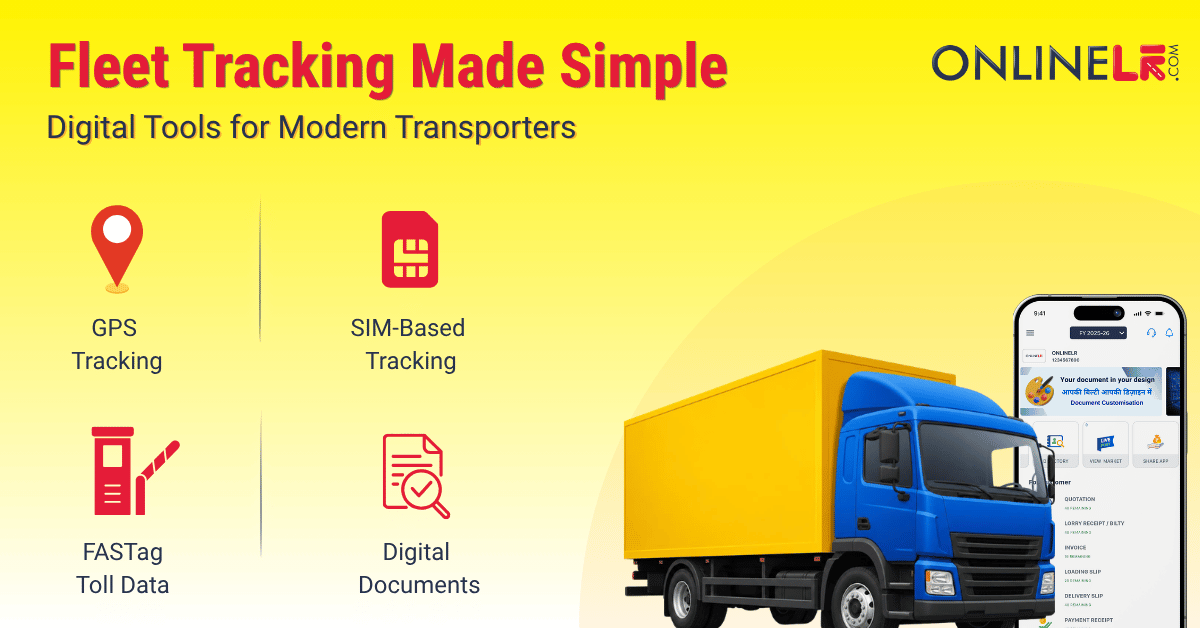
Fleet Tracking Made Simple: Digital Tools for Modern Transporters
Ten years ago, “tracking a truck” meant calling the driver and hoping he picked up. Today, transporters across India have a full stack of digital tools - GPS devices, SIM-based tracking, FASTag toll data, and real-time dashboards — that show exactly where every vehicle is, minute by minute. Combine that visibility with a Transport Documentation App like ONLINELR, and you get a complete picture: where the truck is, and what's happening on paper (Bilty, LR, Invoice, Loading Slip) at every stage of the trip.
This post breaks down the main fleet tracking methods used in India today, and how pairing them with digital documentation gives transporters — from single-truck owners to 40+ vehicle fleets — real control over their operations.
Why Fleet Tracking Matters for Indian Transporters
Fleet tracking India has moved from a “nice to have” to a basic expectation from clients and brokers. Shippers want proof that their goods are moving on schedule, drivers want fewer disputes over delays, and fleet owners want to cut down on fuel pilferage, route deviation, and idle time.
A good truck tracking app addresses all of this — but only when it's paired with solid documentation. Knowing where a truck is means little if the LR, Loading Slip, or Proof of Delivery for that trip isn't equally organized.
GPS Tracking: The Foundation
GPS (Global Positioning System) tracking is the most common method used across Indian fleets. A GPS device installed in the vehicle continuously transmits its location to a central dashboard, giving fleet owners:
- Live vehicle location on a map
- Route history and deviation alerts
- Speed monitoring and harsh-driving alerts
- Geofencing — alerts when a truck enters or exits a defined zone
GPS tracking works well for real-time updates, but its accuracy depends on hardware installation, device maintenance, and network coverage — which is where SIM-based tracking often complements it.
SIM Tracking: A Lighter-Weight Alternative
SIM-based tracking uses the mobile network (via a SIM card in a tracking device or the driver's phone) to estimate vehicle location through cell tower triangulation or app-based GPS data from a smartphone.
It's commonly used by smaller fleets because:
- No separate hardware installation is required if using a driver's phone
- Lower upfront cost compared to dedicated GPS hardware
- Works well in areas with strong mobile network coverage
The trade-off is precision — SIM tracking is generally less accurate than dedicated GPS hardware, especially in low-network zones, but it's a practical entry point for owner-operators and small fleets who aren't ready to invest in full GPS infrastructure.
FASTag Toll Tracking: An Underused Data Source
Every time a truck passes through a toll plaza, its FASTag generates a timestamped, location-tagged transaction. This creates a secondary tracking layer that many transporters overlook:
- Confirms actual vehicle movement along national highways
- Provides an independent cross-check against GPS/SIM data
- Useful for reconciling toll expenses against trip records
- Helps detect route deviations or unauthorized vehicle use
FASTag toll tracking won't give you live, minute-by-minute location like GPS, but it's a reliable audit trail — especially useful when reconciling trip costs against your Transport Ledger and Reports.
Real-Time Updates and Driver Visibility
The real value of fleet tracking isn't the raw location data — it's what you do with it. Modern dashboards convert GPS, SIM, and FASTag data into real-time updates that answer practical questions:
- Is the truck on schedule for delivery?
- Has it deviated from the planned route?
- How long has it been idle, and why?
- Which driver is currently assigned to which vehicle and trip?
Driver visibility — knowing which driver is on which truck, their current trip status, and their delivery history — helps fleet owners assign the right vehicle to the right job, resolve customer queries quickly, and hold drivers accountable without constant phone calls.
Where Digital Documentation Fits In
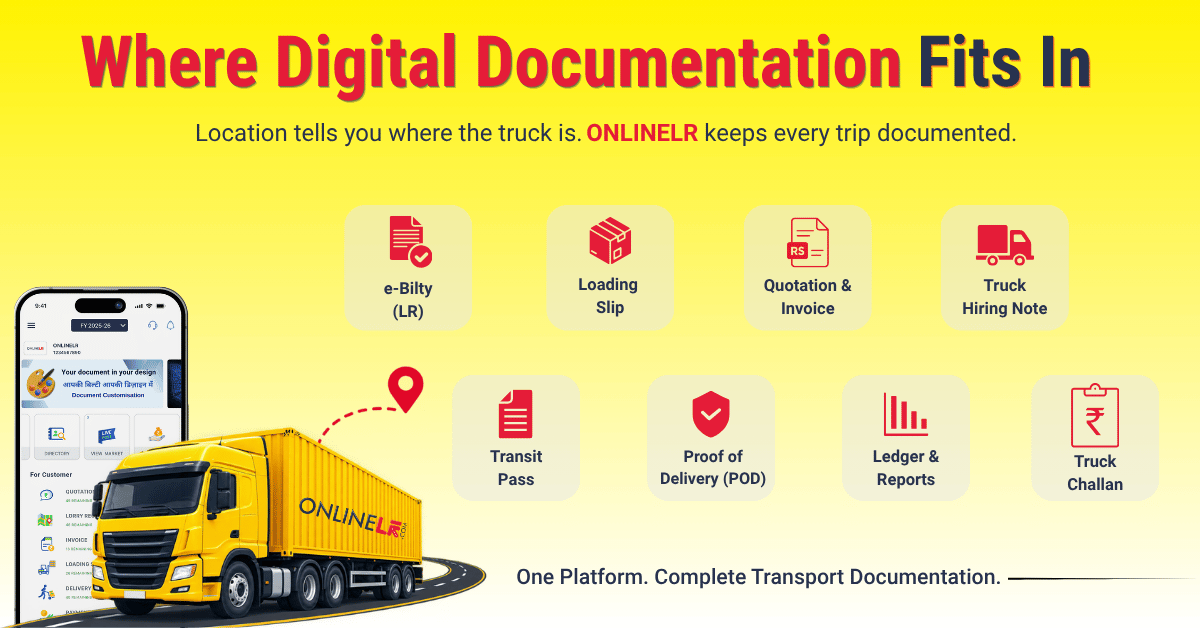
Location tracking tells you where a truck is. It doesn't tell you what was loaded, who authorized the trip, what was quoted to the client, or whether the delivery was confirmed.
That's the layer ONLINELR covers as a Transport Management System (TMS):
- Digital Bilty / e-Bilty (Bilti) / LR: Generate a legally recognized lorry receipt the moment a truck is loaded, so every tracked trip has a matching document.
- Loading Slip: Record what's loaded, on which vehicle, before the truck even leaves.
- Quotation & Invoice: Issue a Quotation to the client and convert it into an Invoice once the trip is confirmed, all from your phone.
- Truck Hiring Note: Formalize vehicle hiring terms digitally, useful when assigning outside vehicles to cover a route.
- Transit Pass: Keep transit documentation ready alongside your live location data.
- Proof of Delivery (POD): Close the loop when the shipment reaches its destination.
- Transport Ledger & Reports: Reconcile trip costs, tolls, and payments against your Bilty and Invoice records.
- Truck challan within seconds: Generate challans instantly instead of manually filling paper forms at the loading point.
Using ONLINELR as your online transport bilty maker, every trip you're tracking on GPS or FASTag also has a digital paper trail — from the first online LR generator entry to the final Proof of Delivery.
This is the difference between simply knowing where a truck is and actually running a well-documented, auditable transport operation.
Bringing It All Together: Ab Transport Hua Online
For a fleet of any size — a single owner-operator or a 40-truck operation — the combination of location tracking and digital documentation removes most of the guesswork from daily operations:
- GPS/SIM tracking tells you where the truck is right now.
- FASTag data cross-checks that movement against toll records.
- ONLINELR ensures every trip has a matching Bilty, LR, Loading Slip, Invoice, and POD — searchable anytime through Reports and the Transport Ledger.
Instead of managing a paper Bilty book in one place and a tracking dashboard in another, transporters get a connected view of both the physical movement and the digital paperwork behind each trip.
Final Word
Fleet tracking India has matured well beyond a phone call to the driver. GPS, SIM tracking, and FASTag toll data together give transporters real-time updates and driver visibility that were unimaginable a decade ago.
But tracking alone is only half the picture — the other half is documentation. With ONLINELR, transporters get an easy-to-use bilty maker, LR generator, and complete Transport Documentation App that keeps every tracked trip backed by a proper digital LR, Invoice, and Loading Slip.
Ab Transport Hua Online. Track the truck. Document the trip. Run your fleet with full visibility, end to end.
Looking for an online bilty creator that keeps pace with your tracked fleet? Download the ONLINELR app and generate your first digital LR in minutes.

 Transporter Login
 Company Login